The cloth
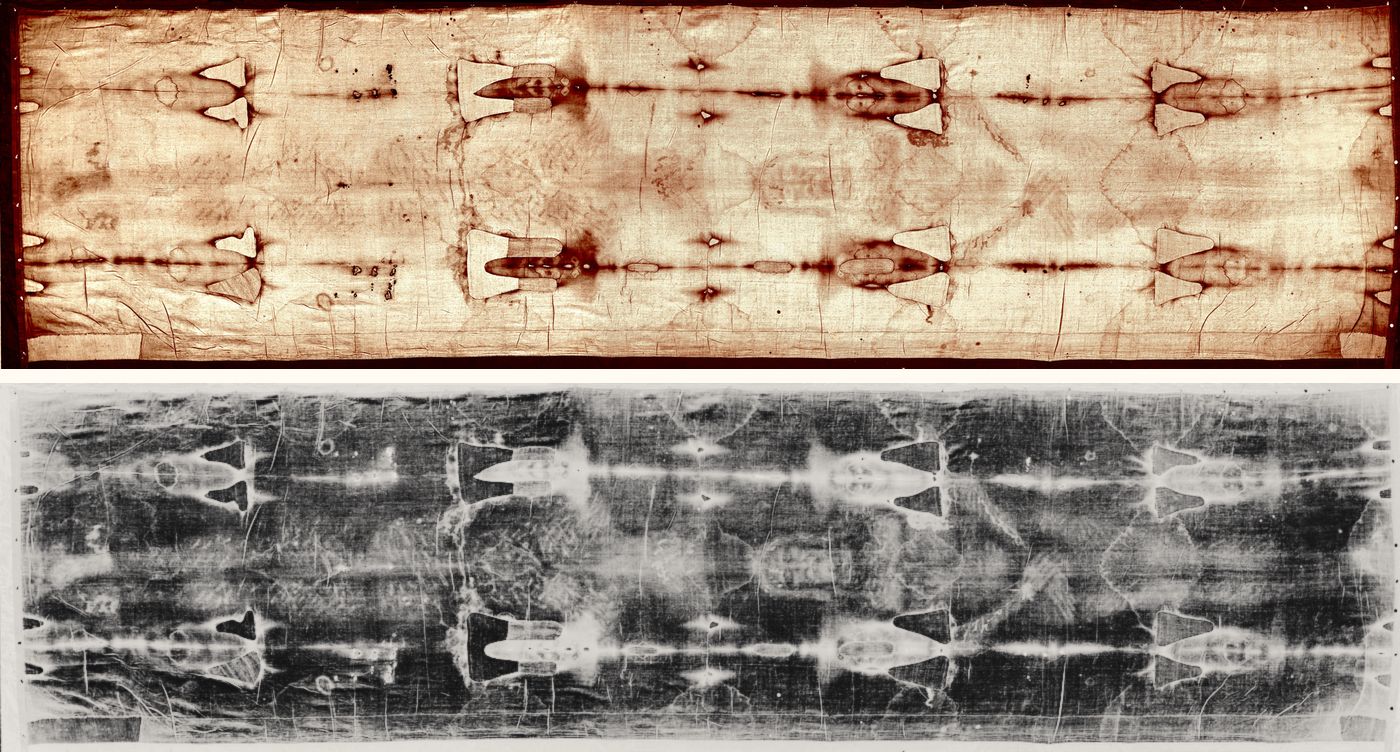
The Shroud of Turin is a strip of linen about 4.4 metres long. On it is the faint, straw-coloured image of a man, front and back, as if he had been laid on one half of the cloth and the other half folded over his head to cover him.
The Gospels say Jesus was buried this way:
"And Joseph buying fine linen, and taking him down, wrapped him up in the fine linen, and laid him in a sepulchre, which was hewed out of a rock."
Mark 15:46
It has been kept in the cathedral in Turin, Italy, since 1578. It is the most studied object in the world.
The negative
In 1898, an Italian photographer named Secondo Pia was allowed to photograph the Shroud. When he developed his glass plate in the darkroom, he nearly dropped it.
On the cloth, the image is faint and hard to read. On his negative, it turned into a clear, lifelike picture of a man's face and body.
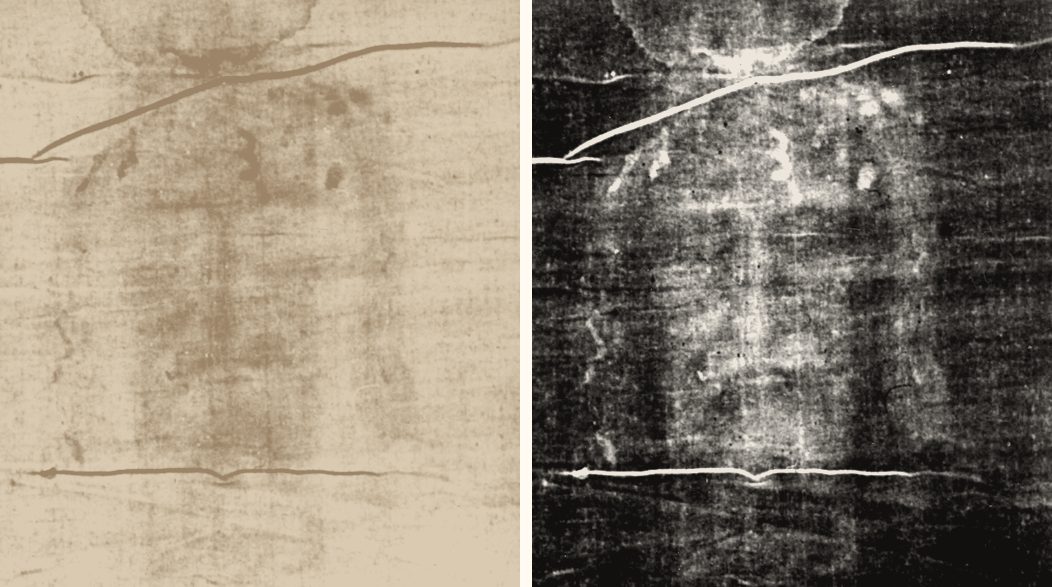
That means the image on the cloth is itself a negative, with light and dark reversed. Photography reversed it back.
The idea of a photographic negative didn't exist until the 1800s. Whoever, or whatever, made this image made a negative centuries before anyone knew what one was.
No paint
In 1978, a team of American scientists, the Shroud of Turin Research Project, spent five days examining the cloth with every instrument they could bring.
They found no paint. No ink. No dye. No brush strokes. No outline. Paint pools and cracks and soaks into a cloth. This doesn't.
The colour isn't something added to the linen. It is the linen fibres themselves, slightly darkened, as if aged in the shape of a man.
Only on the surface
Look closer and it gets stranger. The colour sits only on the very top fibres of each thread, a layer thinner than a thousandth of a millimetre. Turn the threads over, and the fibres underneath are untouched.
Anything liquid would have soaked in. Whatever made this image touched only the outermost surface of the cloth, and nothing else.
3D information
In 1976, researchers put a photo of the Shroud into a VP-8 Image Analyzer, a machine used in space research to turn brightness into height.
Put an ordinary photo or painting into it, and you get a distorted mess. Put in the Shroud, and out came a clear, undistorted 3D figure of a man.
The darkness at every point on the image matches how close the body was to the cloth at that point. No painting or photograph does this.
Nobody can copy it
Put it all together. A negative. No paint. Colour only on the surface. Distance information built in.
No one has ever made a copy with all of these properties. Italian scientists at the ENEA research centre got closest, after years of trying, using extremely short bursts of ultraviolet light from modern lasers. Even then, they could only colour tiny patches of linen. Nothing that existed in the Middle Ages comes close.
The wounds
The man on the Shroud was executed by crucifixion. His wounds match what the Gospels say happened to Jesus, detail by detail.
The scourging. More than a hundred wounds cover the back, shoulders and legs. They match the Roman flagrum, a whip with small weights of metal or bone on each strand. They come from two directions, as if two soldiers stood on either side. "Then, therefore, Pilate took Jesus, and scourged him" (John 19:1).
The thorns. Puncture wounds cover the whole scalp, right across the top of the head. That is a cap of thorns, pressed down over the whole head. "And platting a crown of thorns, they put it upon his head" (Matthew 27:29).
The nails. The nail wound is in the wrist, not the palm. Nails through the palms can't hold a man's weight. The flesh tears. The wrist holds. Medieval artists almost always painted the nails through the palms. The Shroud gets it right, against the art of its own supposed era.
The legs. Crucified men usually had their legs broken to speed up death. The man on the Shroud's legs are not broken. "As they saw that he was already dead, they did not break his legs" (John 19:33).
The side. There is an oval wound between the ribs on the right side, and two different fluids flowed from it:
"But one of the soldiers opened his side with a spear, and immediately there came out blood and water."
John 19:34
Why water? John didn't know. He just wrote down what he saw. But modern medicine does.
A man who has been scourged and crucified goes into shock. Clear, watery fluid builds up in the sac around the heart and around the lungs. A spear driven into the right side of the chest goes through that fluid first, and then into the heart. Out comes water, and blood.
In 1986, the Journal of the American Medical Association published a study of the death of Jesus. Its conclusion: the water "probably represented serous pleural and pericardial fluid," the fluid around the lungs and heart.
Nobody in the first century knew that fluid existed. John recorded a medical detail 1,900 years before medicine could explain it.
Blood first, then the image
The bloodstains are real blood. Scientists Heller and Adler tested them and confirmed it in 1981.
And here's the detail a forger would never have thought of. Under the bloodstains, there is no image. The blood was on the cloth first. The image formed afterwards, around it.
An artist paints the body first, then adds the blood. On the Shroud, it happened the other way round: a bleeding body was wrapped in the cloth, and then the image appeared.
The 1988 test
In 1988, three laboratories radiocarbon-dated a sample of the Shroud and put it between 1260 and 1390 AD. For thirty years, that one number was used to call the Shroud a medieval fake.
That verdict no longer holds.
One corner. All three labs tested pieces from a single spot: one corner of the cloth. It's the most handled part of the whole Shroud, the part held up at public showings for centuries, and the part most likely to have been repaired. A date from that corner tells you about that corner.
It wasn't the same cloth. In 2005, Raymond Rogers, a chemist from the original 1978 team, studied threads from the sample area. He found dye in them that the rest of the Shroud doesn't have. He also found that the main cloth had lost a chemical called vanillin that breaks down slowly over time. The sample area still had it. His conclusion: the 1988 sample was later material woven into the corner as a repair, and the main cloth is far older. He put its age at between 1,300 and 3,000 years.
The raw data didn't hold up. The labs never released their raw measurements. In 2017, a French researcher, Tristan Casabianca, used a freedom of information request to get them. His team's analysis, published in 2019, found the samples didn't agree with each other the way a single, uniform piece of cloth should. Their conclusion: the data cannot support a medieval date.
The new test
In 2022, Liberato De Caro and his team at Italy's Institute of Crystallography dated a thread from the Shroud a different way. Instead of measuring carbon, they used X-rays to measure how far the linen's own structure has broken down with age.
The Shroud's linen matched a sample of cloth from the siege of Masada, dated 55 to 74 AD. The time of the crucifixion.
The method wasn't invented for the Shroud. The same team developed it and tested it on ancient fabrics of known age, publishing the method in 2019, before applying it to the Shroud in 2022.
Unlike carbon dating, this method doesn't destroy the sample, and it isn't thrown off by centuries of smoke, handling and contamination.
It's older than 1260
Two more pieces of evidence put the Shroud on the scene before the date the 1988 test gave.
The Pray Codex. A Hungarian manuscript written between 1192 and 1195, at least 65 years before the earliest 1988 date, shows the burial of Jesus. The burial cloth in the picture has the Shroud's herringbone weave. And it has four small holes in an L shape, matching a set of old burn holes in the real Shroud, exactly.
The Sudarium of Oviedo. John says that in the empty tomb, there were the linen cloths, "And the napkin, that had been about his head, not lying with the linen cloths, but apart" (John 20:7). A cloth said to be that napkin has been kept in Oviedo, Spain, since at least 1075, nearly 200 years before the 1988 date. It has no image, only bloodstains. The blood on it is type AB, the same as on the Shroud, and its stains line up with the wounds on the Shroud's face.
Why this is a big deal
For over three decades, one test did all the work of dismissing the Shroud. That test came from one compromised corner, its own raw data doesn't hold together, and newer testing has placed the linen in the time of Christ. The medieval-forgery hypothesis is no longer sustainable.
What remains is a burial cloth, carrying the forensic record of a Roman crucifixion that matches the Gospel account in precise detail, bearing a photographic negative that no one has explained and no one has reproduced, and now dated by modern methods to the time and place of the event it appears to record.
When John stepped into the empty tomb and saw the linen cloths lying there, "he saw, and believed" (John 20:8).